
Importing recovered paper into Türkiye is subject to environmental rules and permits administered by the Ministry of Environment, Urbanisation and Climate Change (MoEU) and to customs control. Paper mills in Türkiye rely on imported OCC and DLK to blend with local collection. Complying with the permit requirements of the receiving mill, the customs tariff classification (GTIP 4707) and port radiation and contamination inspections requires regional logistics experience. Requirements change over time, so confirm the current rules with the receiving mill and a licensed customs broker.
1. Environmental Permits and Import Conditions for Turkish Mills
Recovered paper is treated as a secondary raw material, and its import into Türkiye is tied to the environmental permits and licences of the receiving paper mill and to the conditions set by the Turkish authorities. In practice the mill, not the exporter, is the party that holds the permission to import.
Recovered paper is normally classified under the non-hazardous "green list" of the Basel Convention and under customs tariff heading GTIP 4707 (for example 4707.10 for unbleached kraft or corrugated paper). Authorities may attach conditions to import permissions, and these can change: confirm the current requirements with the receiving mill and a licensed customs broker before you contract, and keep pre-shipment inspection and contamination documents ready.
2. Port Inspection Protocols: Ambarlı, Mersin, Gemlik and Aliaga
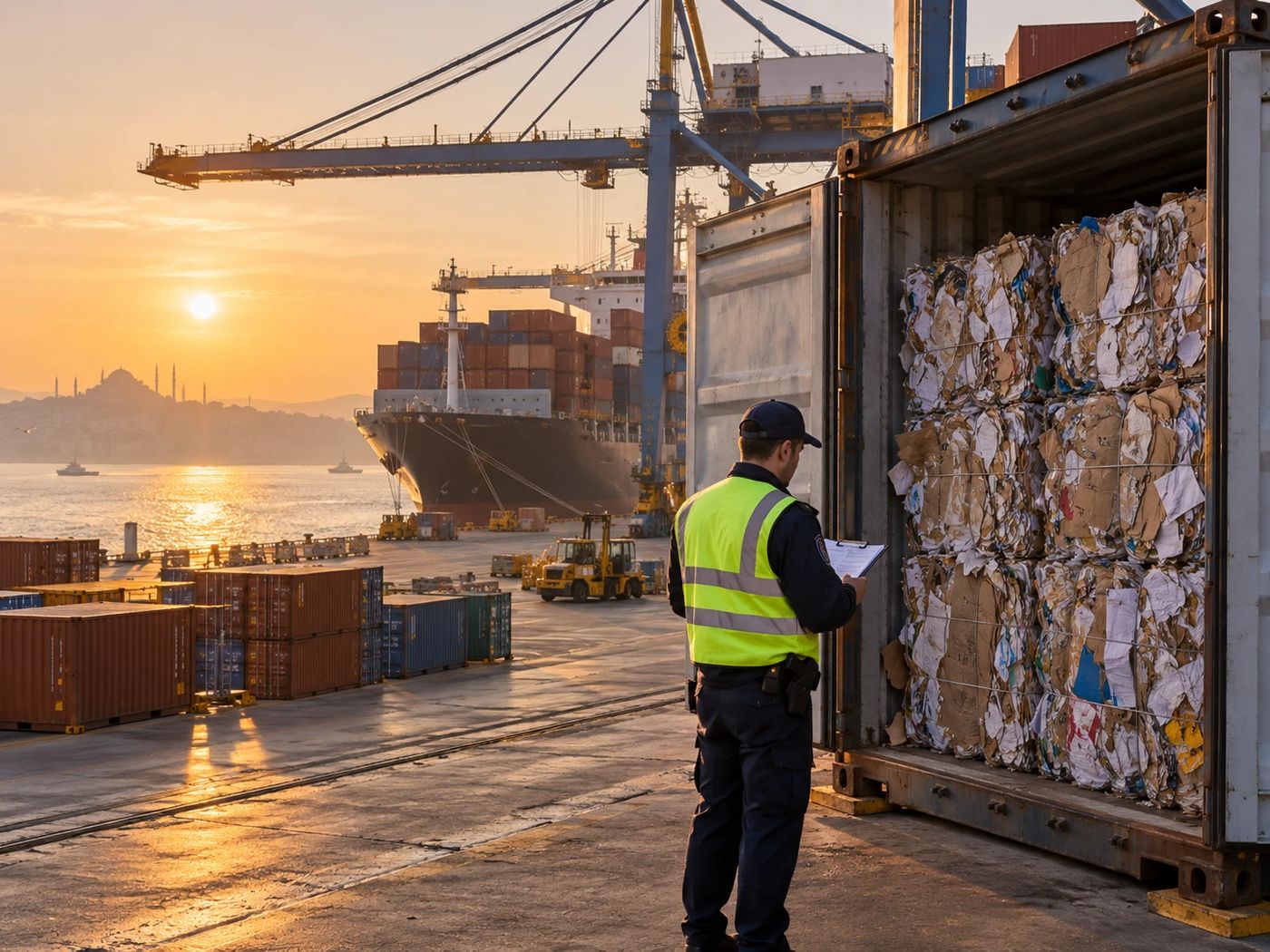
Upon container vessel arrival at major Turkish ports (Ambarlı Istanbul, Mersin International Port, Gemlik Borusan, or Aliağa Izmir), the container is subjected to rigorous customs and environmental verification:
1. Radiation Portal Scanning: Every container passes through a stationary radiation detection portal. 2. Visual Physical Inspection: Customs officers and environmental inspectors break container seals to verify bale integrity, checking for banned municipal garbage or excessive plastics. 3. Moisture Probe Testing: Random core samples are measured to cross-verify the bill of lading declared moisture.
3. Documents and Delivery Terms for Shipments to Türkiye
A typical shipment is sold CIF or CFR to a Turkish port: the exporter books the sea freight and the buyer clears customs. The basic documents are the commercial invoice, the packing list with bale counts and weights, the bill of lading, the certificate of origin and, when the contract requires it, an independent pre-shipment inspection report. Because Türkiye controls the import of waste and secondary raw materials, the receiving mill's environmental permit and any importer authorisation required at the time must be in place before the goods sail.
Requirements are set by the Turkish authorities and can change. Always confirm the current rules with the receiving mill and a licensed customs broker in Türkiye, and agree in the contract who is responsible for obtaining each document and who bears the cost if a shipment is delayed.
4. Freight Planning: Containers, Weights and Timing
Recovered paper is normally shipped in 40-foot high-cube containers loaded to the permitted payload with tightly pressed, wire-tied bales. Overloading beyond legal road or terminal limits causes fines and delays, so confirm the maximum gross weight for both the origin and destination legs. Book space early in peak season, and ask the shipping line about free days for demurrage and detention at the Turkish port.
Protect the load from moisture: use dry containers, check floors and door seals, and photograph the loading. Transit and port handling times vary by route and season; ask for a realistic schedule and build a buffer into the mill's inventory plan.
5. Why Shipments Are Delayed or Rejected, and How to Avoid It
The most common causes are contamination above the agreed limit, wet or mouldy bales, mixed grades, missing or inconsistent documents, and an incorrect product description or tariff classification on the invoice.
Prevent them with a written specification, an independent inspection at loading, clear photographs of every bale row, and a checked document set sent to the buyer's broker before the vessel arrives.
6. The Import Journey Step by Step
Seeing the whole sequence makes it easier to plan. The exact requirements change with regulations, but the flow of a typical shipment is stable.
1. Agreement: buyer and seller sign a contract with the grade, quantity, price, delivery term and documents. 2. Permission check: the receiving mill confirms it can import this material and the exporter confirms the shipment matches the description. 3. Booking: the exporter (CIF or CFR) or the buyer (FOB) books space with a shipping line for the loading port and dates. 4. Loading and inspection: bales are loaded, an inspector samples and reports, and photographs are taken. 5. Documents: the bill of lading is issued and the document set is sent to the buyer and broker. 6. Sea transport: the vessel sails; the buyer tracks arrival. 7. Arrival and customs: at the Turkish port the broker files the declaration, and authorities may inspect and test the goods. 8. Release and delivery: after clearance the container is trucked to the mill, unloaded and weighed, and quality is checked against the contract. 9. Settlement: payment is completed, or claims are raised if the goods do not match.
7. Who Does What: Exporter, Mill, Broker and Shipping Line
Confusion about responsibilities causes delays, so it helps to know each party's role.
The exporter or trading company selects the supplier, agrees the specification, arranges loading and inspection, books the vessel under CIF or CFR, and prepares the shipping documents.
The receiving mill is the importer of record in most cases. It holds the environmental permit, receives the goods, tests them against the contract and pays.
The customs broker in Türkiye prepares and files the import declaration, checks the tariff classification and documents, and coordinates with customs and port authorities on the mill's behalf.
The shipping line carries the container and issues the bill of lading. It sets the free days at the port after which demurrage or detention charges apply.
The inspection company gives an independent view of quality and quantity at loading, which protects both buyer and seller.
8. The Cost Elements of an Import Shipment
The price of the material is only one part of the cost of getting it to the mill. When you compare offers, list every element so that quotes on different terms can be compared fairly.
Typical elements are: the price of the material at origin; loading and inspection costs; sea freight and origin port charges; marine insurance; port and terminal charges at the Turkish port; customs brokerage and any duties or taxes that apply; inland trucking to the mill; and demurrage or detention if the container is held beyond the free days.
Under CIF or CFR the seller's price already includes freight (and insurance for CIF), so the buyer adds the costs from the destination port onwards. Under FOB the buyer adds freight and insurance too. Whatever the term, ask your broker for the current tariff and any duties before comparing.
9. A Practical Checklist Before You Book the Vessel
Go through these points before committing to a shipment:
1. The receiving mill has confirmed in writing that it can import this material now. 2. The contract names the grade, quantity, moisture and contaminant limits, price, incoterm and payment terms. 3. An independent inspector is appointed and the sampling method is agreed. 4. Freight is quoted with clear free days at the Turkish port and the total weight limit for the route. 5. The document list is agreed and a broker in Türkiye has seen the draft documents. 6. Loading photographs are required for the empty container, each row, the closed doors and the seal. 7. Insurance is arranged where required and the risk transfer point is understood. 8. Delivery to the mill (trucking and unloading slot) is planned in advance. 9. Claim deadline and procedure are written in the contract.